Loading...
Searching...
No Matches
bntables.h File Reference
#include "encode.h"#include "gpu.h"#include <cstdint>#include "data/pmj/keys.txt"#include "data/pmj/ranks.txt"#include "data/sobol/keys.txt"#include "data/sobol/ranks.txt"#include "data/lattice/keys.txt"#include "data/lattice/ranks.txt"
This graph shows which files directly or indirectly include this file:
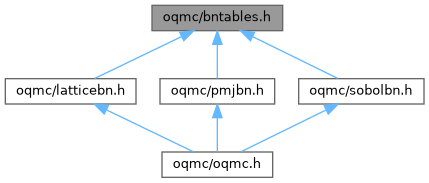
Go to the source code of this file.
Classes | |
| struct | oqmc::bntables::TableReturnValue |
| Return type for table value. More... | |
Namespaces | |
| namespace | oqmc |
| namespace | oqmc::bntables |
| namespace | oqmc::bntables::pmj |
| namespace | oqmc::bntables::sobol |
| namespace | oqmc::bntables::lattice |
Functions | |
| template<int XBits, int YBits, int ZBits> | |
| constexpr TableReturnValue | oqmc::bntables::tableValue (std::uint16_t pixel, std::uint16_t shift, const std::uint32_t keyTable[], const std::uint32_t rankTable[]) |
| Lookup value pair from table. | |
Variables | |
| constexpr auto | oqmc::bntables::xBits = 8 |
| 256 pixels in x. | |
| constexpr auto | oqmc::bntables::yBits = 8 |
| 256 pixels in y. | |
| constexpr auto | oqmc::bntables::size = 1 << (xBits + yBits) |
| 2^16 table size. | |
| constexpr std::uint32_t | oqmc::bntables::pmj::keyTable [] |
| Optimised blue noise key table for pmj. | |
| constexpr std::uint32_t | oqmc::bntables::pmj::rankTable [] |
| Optimised blue noise rank table for pmj. | |
| constexpr std::uint32_t | oqmc::bntables::sobol::keyTable [] |
| Optimised blue noise key table for sobol. | |
| constexpr std::uint32_t | oqmc::bntables::sobol::rankTable [] |
| Optimised blue noise rank table for sobol. | |
| constexpr std::uint32_t | oqmc::bntables::lattice::keyTable [] |
| Optimised blue noise key table for lattice. | |
| constexpr std::uint32_t | oqmc::bntables::lattice::rankTable [] |
| Optimised blue noise rank table for lattice. | |
Detailed Description
Pre-computed and optimised blue noise tables used to decorrelate between pixels, and extend the base sampler implementations with blue noise properties. A generalised method extending 'Lessons Learned and Improvements when Building Screen-Space Samplers with Blue-Noise Error Distribution.' by Laurent Belcour and Eric Heitz was used to optimise the tables. Lookups for the table can apply constant random shifts for different domains, allowing a single table to be re-used for N domains.